
You found a crack, a stain, or a soft spot. Here’s how CMB Jersey Shore Stucco and EIFS Repair & Installation explains the difference to owners. One contractor says patch it. Another says tear it off. Who’s right? Stucco repair vs. remediation comes down to one thing most people never see: what’s happening behind the wall.
The difference in one sentence
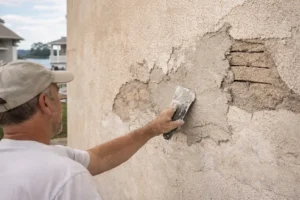
Repair fixes the surface when the wall behind it is dry. Remediation removes stucco or EIFS to fix wet or rotted material behind it, then rebuilds the wall.
Crack size doesn’t decide it. Moisture does.
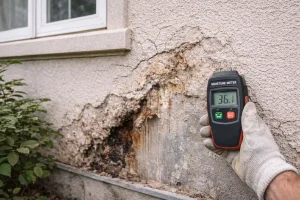
A wide crack on a dry wall can be a simple fix. A hairline crack under a window can sit on top of rotted sheathing. You can’t tell from the outside. A moisture test is what decides repair vs. remediation.
That’s why a quote for either one, given from the driveway with no testing, is a guess. Our stucco inspection page explains how testing works.
Testing usually means small probe holes where walls are most likely to be wet. That means under windows, at roof edges, and near the bottom of the wall. Each reading tells you how wet the wood is at that spot. A pattern of high readings points to remediation. Scattered normal readings point to repair.
What the readings tell you
Normal readings behind a crack or impact point usually mean repair: crack repair, patch repair, or resurfacing. High readings in the wood mean remediation. The warning signs that point toward remediation are listed on our stucco remediation page, along with how the work is done.
There’s a middle option
Remediation doesn’t always mean the whole house. If testing shows wet readings only on one side, or only around certain windows, you can remediate just those wall faces. Then repair and reseal the rest. This partial approach is common when damage is limited. Ask any contractor who quotes a full tear-off to show you the readings that justify it.
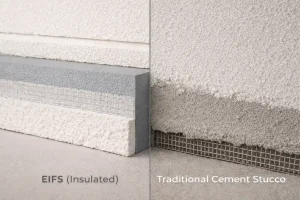
On EIFS, the same rule holds. Our synthetic stucco repair page explains the barrier vs. drainage twist.
What each level costs
These are national figures from industry guides, not CMB prices:
- Professional moisture testing: about $500 to $1,500 per home (Angi)
- Small stucco repairs: about $8 to $20 per square foot (This Old House)
- Removing stucco alone: about $3 to $6 per square foot, before any wood or rebuild (This Old House)
- Mold remediation, if needed: about $10 to $25 per square foot (This Old House)
Remediation totals vary the most, because no one knows how much wood is wet until the wall is open. A good proposal sets an allowance for wood replacement and tells you how overages are handled. For a full cost walkthrough, see how much stucco repair costs in NJ.
Red flags in a remediation proposal
- No moisture readings attached
- No plan for the windows. One building science expert told 6abc that a remediation plan that doesn’t pull and reset the windows is a red flag.
- No allowance for wet wood, or no word on how extra wood is billed
- No mention of a drainage layer in the new wall
Insurance is another question. Our post on insurance and stucco water damage covers what policies usually cover.
CMB Jersey Shore Stucco and EIFS Repair & Installation has done both repair and remediation across New Jersey since 1985. We’d rather tell you a repair will do than sell you a tear-off you don’t need. The readings make that call, not us.
Not sure if you need repair or remediation? Call CMB at (732) 400-4020 to set up testing.
Frequently Asked Questions
Can stucco remediation be done on just part of a house?
Yes. If testing shows damage only on certain walls or around certain windows, those areas can be remediated and the rest repaired.
How do I know if I need stucco remediation?
Moisture testing is the only reliable way. High readings in the wood behind the stucco mean remediation. Normal readings usually mean repair.
Is stucco remediation covered by insurance?
Sometimes. It depends on what caused the damage and your policy. Slow leaks from aging joints are often excluded. See our insurance post for what to ask your carrier.
How long does stucco remediation take?
It depends on how much wall is opened and how much wood is replaced. A single wall face is a much shorter job than a whole house. Your scope should include a schedule.