
It’s one of the first questions people ask when they find rot behind their stucco. The honest answer is: sometimes. It depends on what caused the damage and how long it went on. This guide explains how many policies treat stucco water damage, so you can have a clearer conversation with your insurer. It’s general information, not legal or insurance advice. Your policy wording is what counts.
The Big Divide: Sudden vs. Slow
Most homeowners policies are built to cover sudden, accidental damage. They aren’t built to pay for problems that develop slowly.
Stucco water damage almost always develops slowly. Water gets in at a window corner or a missing flashing, a little at a time, for months or years. That’s exactly the kind of loss many policies leave out.
Exclusions That Often Apply to Stucco Claims
Policies differ, but these exclusions come up often:
- Continuous or repeated seepage. Many policies exclude water that leaks over weeks, months, or years. Some set a time limit, such as 14 days.
- Wear and tear. Aging caulk, old sealant, and worn stucco are usually treated as upkeep.
- Mold, fungus, and rot. Many policies exclude these or cap what they’ll pay.
- Faulty workmanship. Poor original installation is often excluded, though damage that results from it may be treated differently depending on the policy.
- Flood. Standard homeowners policies don’t cover flood. That takes separate flood insurance.
When a Claim May Have a Better Chance
Coverage is more likely to come into play when a sudden event causes the damage. For example:
- A storm breaks a window or tears off trim, and rain pours into the wall.
- A pipe inside the wall bursts. Many policies cover the water damage but not the broken pipe itself.
- A falling tree or other impact cracks the wall open.
Even then, the insurer will look at whether older damage was already there. Two homes can have the same rotted sheathing and get different answers because the cause is different. That’s why the details you gather matter.
What to Do Before You Call Your Insurer
- Read the exclusions section of your policy, not just the summary page.
- Take dated photos and video of the damage, inside and out.
- Write down when you first noticed each sign: stains, smells, soft spots.
- Take reasonable steps to stop more damage, like covering an opening. Most policies expect this.
- Don’t tear out damaged material before the adjuster sees it, unless it’s a safety issue.
- Get a written description from a stucco contractor of what they find and the likely cause. New Jersey’s insurance department notes it can help to have your contractor talk directly with the adjuster.
Save receipts for any emergency work, too. For a sense of what repairs can run, see what stucco water damage repair costs.
Shore Homes: Flood and Wind Are Different
If your home is near the bay or ocean, keep flood and wind separate in your mind. Water rising from outside is usually a flood insurance matter, not a homeowners one. Wind damage is typically handled under your homeowners policy, but terms vary. Ask your agent how your policies split it before storm season.
Buying a Stucco Home? Think About This Now
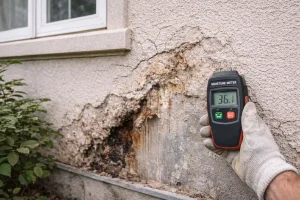
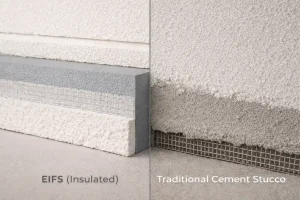
Insurers generally don’t pay for damage that was there before you owned the home. If you’re buying a house with stucco or EIFS, a moisture test during your inspection period is your best chance to find hidden damage while the seller can still address it. Our guide for buyers and sellers of stucco homes covers how to fit that test into a New Jersey contract. Our stucco inspection uses small test holes and moisture readings, then gives you a written report.
One Question to Ask Your Agent About Matching
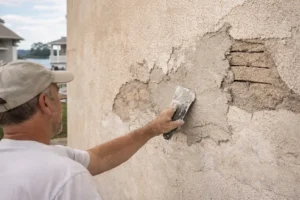
Stucco repairs live or die on color and texture. How insurers handle a patch that can’t be matched depends on the policy and the state. Some states require insurers to replace enough to give a reasonably uniform appearance; others leave it to the policy wording. Ask your agent how yours handles matching before you ever need it.
If Your Claim Is Denied
Ask the insurer to explain the denial in writing and point to the exact policy language. If you think the claim was handled unfairly, the New Jersey Department of Banking and Insurance takes consumer complaints. Its consumer hotline is 1-800-446-7467. A public adjuster or an attorney can also review your policy.
Whatever insurance decides, the wall still has to be fixed right. Stucco water damage repair starts with finding exactly where the water got in.
CMB Jersey Shore Stucco and EIFS Repair & Installation has repaired water-damaged stucco and EIFS since 1985. We’ll show you what we find. Call CMB at (732) 400-4020.
Frequently Asked Questions
Does homeowners insurance cover stucco cracks?
Usually not on their own. Cracks from age, settling, or wear are treated as upkeep. If a storm or an impact caused the damage, it may be a different story.
Will insurance pay for mold behind my stucco?
Many policies leave out mold or cap what they pay for it. It may depend on whether the water that caused the mold came from a sudden, covered event. Read the mold section of your policy.
Should a stucco contractor look at the damage before the adjuster?
It helps to know what you’re dealing with. Just don’t remove damaged material until the adjuster sees it, unless it’s a safety issue. Photos and a written note on the cause help both of you.