
Home » Repairs Plaster in Long Branch
Stucco and EIFS experts serving the Jersey Shore since 1985
✓ Over 40 years in business
 Founded 1985
 Still owner-involved on every project not just one system
What’s Covered on This Page
Need Repairs Plaster? Call (732) 400-4020

Quick Summary:
A brown stain or a soft, bulging patch on your plaster almost always means water has gotten in behind the wall. The stain itself isn’t the damage, it’s the warning sign. Homes near the water in Long Branch face extra risk because
salt air and wind-driven rain push moisture into small cracks faster than they do in inland towns.
Here’s what most people don’t realize. That brown ring on the wall isn’t the problem. It’s proof the problem has already been going on for a while.
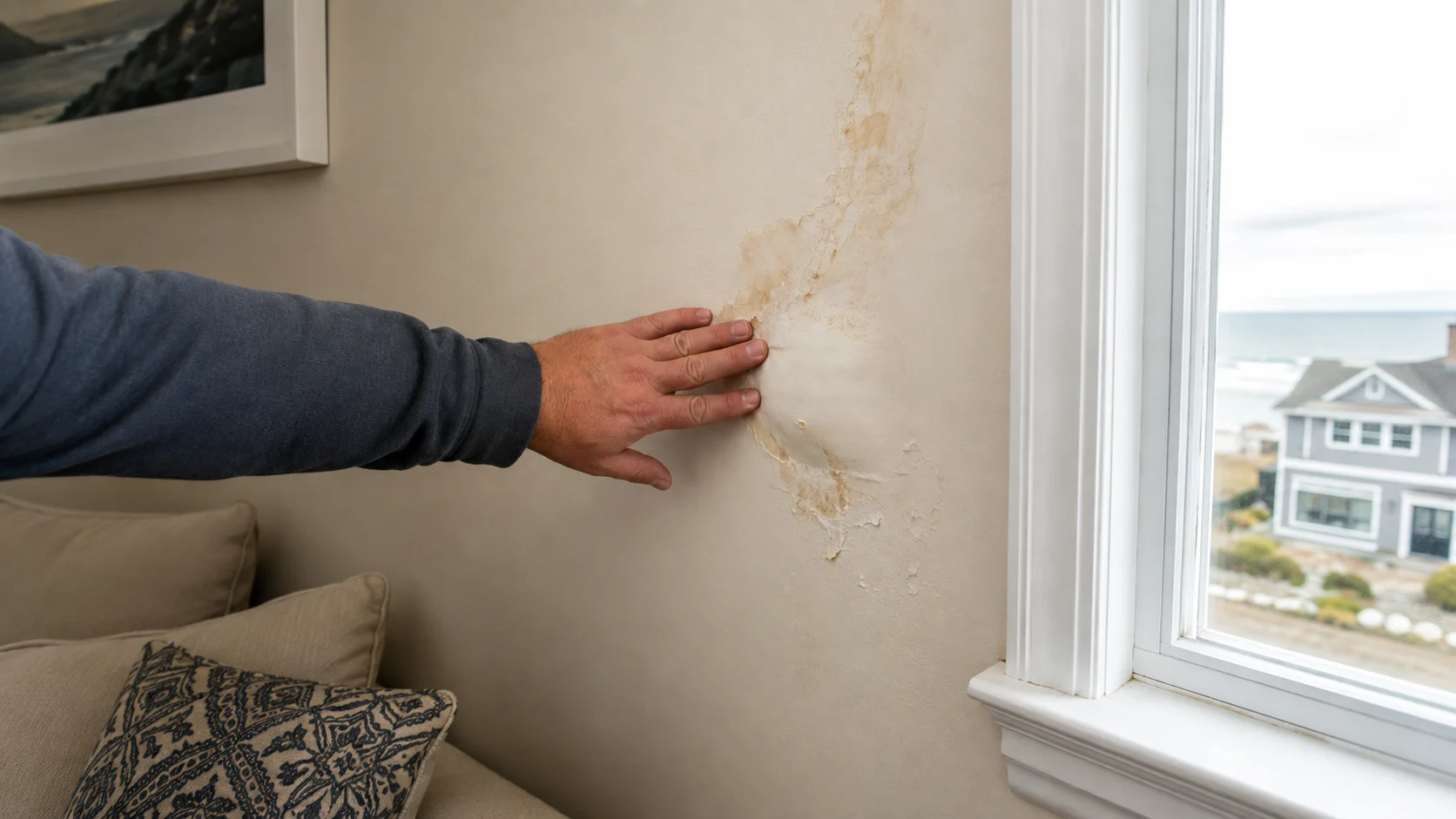
Water usually gets behind plaster through a hairline crack, a bad flashing joint, or a spot where the caulk failed years ago. It just sits there, soaking into the wall assembly, until it finally shows up as a stain, a soft spot you can push a finger into, or plaster that bulges out like it’s swelling. We see this often on homes closer to the water, where salt air and wind-driven rain hit the walls harder than they would a few miles inland.
None of these fix themselves. Left alone, moisture keeps working its way deeper into the wall assembly, and the repair gets bigger every season it sits.
Not every crack means you need to rip out a whole wall. That’s the first thing we tell people. Plaster is tougher than folks think, and it can often be patched and blended so well you’d never know it was damaged. Drywall is a different animal. Once water gets behind it, the paper backing soaks it up like a sponge, and it never really comes back from that.
Older homes near Long Branch’s West End section still have real lath and plaster walls built before drywall was common. Those walls can usually be repaired instead of torn out, even after decades of settling cracks. Newer additions built with drywall don’t get that same second chance once moisture gets in.
So how do you know which one you’re dealing with? Press on it, gently. If it sounds and feels solid, it’s likely a repair. If it’s soft and gives under your finger, that’s a bigger job. And if you’re not sure either way, we’d rather come take a look before you spend money guessing. Call (732) 400-4020
Not every crack means trouble. Let’s be honest about that.
Small hairline cracks in the paint layer are common on stucco homes near the Jersey Shore. Sun, salt air, and normal house settling cause them. If the crack is thin as a pencil line and isn’t letting water behind the wall, a homeowner can often fill it with a paintable exterior caulk and move on. Same goes for a nail hole from a hanging plant bracket or a small ding from a ladder. Those are cosmetic.
How do you know if it’s cosmetic? Press on the area around the crack. If the wall feels solid and there’s no dark staining or soft spots, you’re probably fine to patch it yourself.
Here’s where it stops being a do-it-yourself job. If the crack is wider than a pencil, if it’s growing, or if you see brown staining, bubbling, or a soft spongy spot when you press on it, that’s water finding its way in. At that point it’s not cosmetic anymore, it’s the wall telling you something is wrong underneath. We’ve seen homes near Franklin Avenue where a nail hole got ignored for a season, and the water behind it did real damage to the sheathing before anyone noticed from outside.
So check it, press on it, look for staining. If it’s clean and dry, patch it and enjoy your weekend.
Thinking about Repairs Plaster? Let’s talk.
Call (732) 400-4020. CMB Jersey Shore Stucco and EIFS Repair & Installation is ready to help.
Here’s the part most contractors skip past. Getting the crack filled is the easy half. Getting the patch to disappear is the skill.
Stucco finish isn’t flat. It has a texture pattern, sand float, dash, smooth trowel, and that pattern has to be laid down by hand to match what’s already on the wall. Color is its own challenge. Sun fades stucco unevenly over the years, so the shade near your gutter may not match the shade by the front door anymore. We mix and test color on site before committing to the wall, sometimes more than once, until it reads right against the surrounding surface.
This is where our team spends real time. A patch that looks bad wasn’t a bad repair, it was a rushed texture match. We work on both traditional cement stucco and EIFS finishes, and each one behaves differently under a trowel. EIFS finish coat is thinner and more sensitive to hand pressure than a hard-coat stucco finish, so the technique has to change with the system.
Will every patch be invisible? Almost always, yes, if the surrounding stucco is in decent shape. But if the whole wall is chalky, faded, or covered in old repairs, a fresh patch can still stand out a little next to tired stucco. That’s not a failed match, that’s an old wall showing its age.
Worth knowing: Ask any contractor how they handle texture and color matching before they start. If they don’t test color on the wall first, that’s a red flag. Call (732) 400-4020
Every plaster repair job in Long Branch gets priced by scope, not by a flat rate. That’s just how this trade works. A small hairline crack patch costs less than a section where water got behind the wall and rotted the sheathing underneath.
So what actually moves the number? A few things.

Here’s the thing homeowners get wrong most often, they assume a bigger crack always means a bigger bill. That’s not always true. We’ve patched wide cracks in twenty minutes and spent hours on a small stain because it meant opening the wall to check for rot.
Before you hire anyone for plaster repair, ask what’s driving their number. A contractor should be able to tell you whether you’re paying for surface work or for fixing what’s happening underneath.
Want a straight answer on what your wall needs? Call CMB Jersey Shore Stucco and EIFS Repair & Installation at (732) 400-4020 and we’ll walk through it with you. Call (732) 400-4020
Common questions about Repairs Plaster
We aim to get out quickly once you call, especially if you’re seeing active staining or a soft spot. Water damage behind plaster doesn’t wait, and the longer it sits, the more it spreads into the wall assembly. If you’re in Long Branch near the water, salt air and wind-driven rain can push that damage along faster than in inland homes. Call us and describe what you’re seeing, and we’ll get you on the schedule based on how urgent it looks.
We start by pressing on the damaged area to check if it’s solid or soft. A solid wall with a hairline crack is usually a simple repair. A soft, spongy spot means water has already gotten in behind the plaster. We’ll walk you through what we find, explain whether it’s a patch job or something bigger, and give you a clear plan before any work starts. No guessing, no surprises once we’re on site.
Salt air and wind-driven rain push moisture into small cracks faster than they would a few miles inland. This is common in homes closer to the water, where wind carries salt and rain straight at the walls. A crack that would sit harmless for years in an inland home can start letting water in much sooner near the shore. That’s why we check homes in this area a little differently, paying close attention to flashing joints and old caulk lines.
Press on it gently, and if it feels solid with no staining, it’s usually just cosmetic. Hairline cracks under a pencil’s width, small nail holes, and surface scuffs are typically fine to patch yourself. But if the crack is growing, wider than a pencil line, or shows brown staining or a soft spot, that’s water finding its way behind the wall. At that point it’s not a weekend fix anymore, and it’s worth having someone take a real look.
Most older plaster walls can still be repaired instead of replaced, even after years of settling cracks. Homes in the West End section of Long Branch often still have original lath and plaster walls built before drywall became common, and that plaster holds up well to patching. Drywall doesn’t have that same second chance once water soaks into the paper backing. If your home has true plaster walls, there’s a good chance we can fix the damage without opening up the whole section.
In most cases, yes, if the surrounding wall is still in decent shape. Getting the crack filled is the easy part, but matching the texture and color takes real time and testing on site before we commit to the wall. Stucco fades unevenly over the years, so we check the color against the exact spot we’re patching, sometimes more than once. If the whole wall is chalky or faded from age, a fresh patch may still stand out slightly next to it.
With nearly 40 years of experience since 1985, we at CMB Jersey Shore Stucco and EIFS Repair & Installation, have been perfecting the art of standardized and/or customized stucco finishes. Call Now (732) 400-4020
Effective & Fast Service
Available for 24/7 Emergency Assistance
Quick & Easy Communication
Effective & 100% Satisfaction Guarantee
FREE Appraisal with NO Commitment
Cost-Efficient & Reasonable Pricing
Flexible Schedule at Your Convenience
Awesome 5-Star Customer Satisfaction
CMB Jersey Shore Stucco and EIFS Repair & Installation’s residential and commercial work is always accomplished with
excellent craftsmanship for beautiful and durable results.
 Call (732) 400-4020