
Home » Customized Stucco in Long Branch
Stucco and EIFS experts serving the Jersey Shore since 1985
✓ Over 40 years in business
 Founded 1985
 Still owner-involved on every project not just one system
What’s Covered on This Page
Need Customized Stucco? Call (732) 400-4020

Quick Summary:
Customized stucco repair only works if you know exactly what’s on the wall first. Traditional cement stucco and EIFS look almost identical from the driveway, but they behave very differently once water gets behind them. We check the wall system, the crack pattern, and the moisture readings before we ever pick up a trowel.
Every custom stucco job starts the same way for us. We don’t guess, we walk the wall first. CMB Jersey Shore Stucco and EIFS Repair & Installation has been reading cracks and stains on Jersey Shore homes since 1985, and the first question is never about color. It’s about what’s underneath.
Traditional hard coat cement stucco and EIFS foam systems get repaired in two completely different ways, and mixing them up makes a fix fail fast. So before we match texture or color, we figure out which system your home actually has. A lot of Long Branch homes near the oceanfront went up during the building boom of the 80s and 90s, and plenty of owners have no idea which one they own.
Here’s the part that matters most. A crack, a bulge, a dark stain, none of that is the real problem. Water intrusion behind the wall is the real problem. What you see on the surface is just the symptom, showing up months or even years after moisture first got in.
Homes built before 1999 with EIFS often lack a drainage plane. Standards improved after that, but most owners have no idea which version is on their exterior wall. That’s exactly why we check before we quote anything. Call (732) 400-4020
Here’s the thing most contractors won’t tell you. Slapping new stucco over a crack isn’t a repair, it’s a patch, and patches show.
A custom repair means matching what’s already on your wall, not just covering the hole. That means matching the texture pattern, the color, and the sheen, all at once. Miss one of those and the patch sticks out like a bandage. We’ve walked up to plenty of homes near Long Branch’s West End where salt air off the ocean has faded the stucco unevenly over the years. That kind of weathering makes color matching trickier than it sounds, since the new patch has to account for sun and salt exposure, not just the original paint color.
Getting this right takes more than a bucket of premixed stucco.
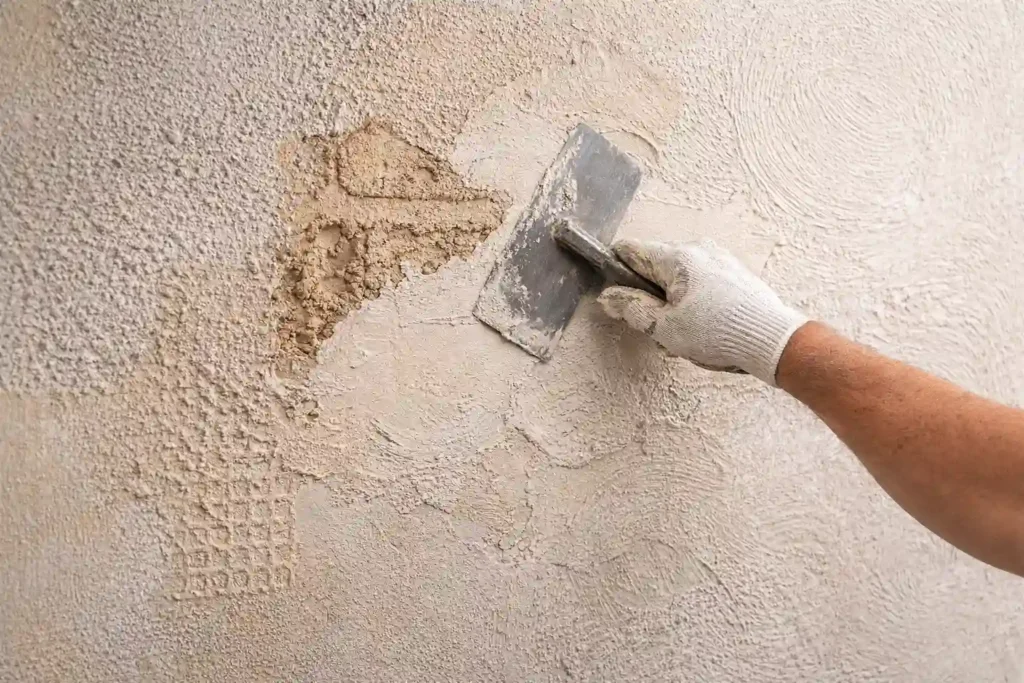
Most of the time, homeowners call us after another contractor left behind a patch that looks like a patch. We’ve worked with both traditional cement stucco and EIFS long enough to know each one behaves differently when you’re trying to blend new work into old. That experience is what separates a repair you can spot from the street from one you can’t.
Here’s the truth. Most stucco problems don’t need a full wall redo. If you’ve got one cracked corner near a window, or a small stained patch under a gutter, that’s usually a job we can fix in place. We cut out the damaged section, match the texture, match the color, and blend it in so it doesn’t stand out. Most of the time, that’s genuinely all it takes.
So when does a full recoat make sense? When the damage isn’t isolated, that’s when. If cracks are spreading across multiple walls, or you’re seeing staining in several spots at once, that usually points to water getting in behind the whole system, not just one corner.
We see this a lot on older homes near Long Branch’s oceanfront on Ocean Avenue, where salt air and wind driven rain wear on stucco year after year. Some of those homes still have EIFS installed before 1999, before drainage planes became standard. Without one, moisture gets trapped instead of draining out, and a patch alone won’t solve that.
So how do you know which one you’ve got? Look at the pattern. One spot, one cause, likely a repair. Multiple spots, staining in different rooms, or a wall that feels soft to the touch, that’s worth a real inspection before anyone touches a trowel.
Need help with Customized Stucco?
Call (732) 400-4020. CMB Jersey Shore Stucco and EIFS Repair & Installation is ready to help.
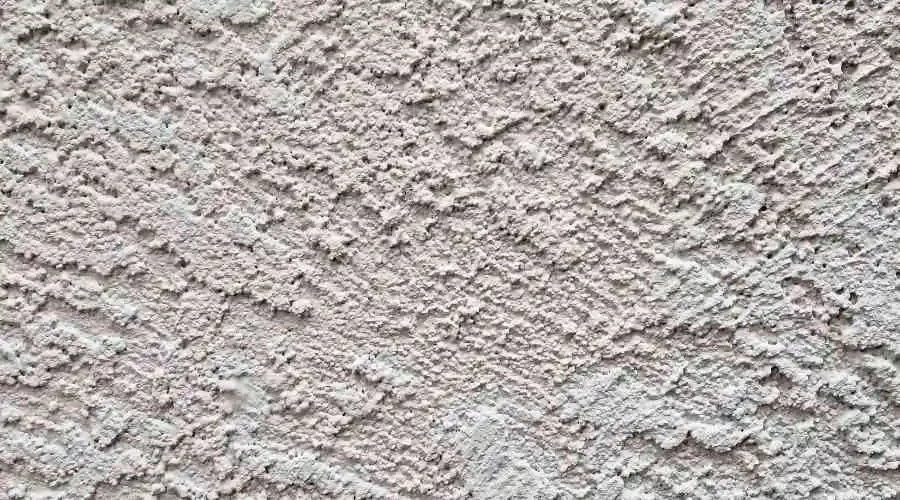
A patch only disappears if we plan for it. That’s the whole trick behind custom stucco work, blending new material into old so nobody can point to where the damage was. Before we touch your wall, we look hard at the existing finish. Texture first, then color.
Here’s something most homeowners don’t think about. Stucco on a house near Ocean Avenue fades differently on the ocean side than it does on the shaded side. Salt air and constant sun bleach the surface over the years, so the south wall might be a shade lighter than the north wall by the time we show up. We factor that in before mixing a single batch.
That last one matters more than people realize. Water intrusion doesn’t always show up where the damage started. A stain near a window can trace back to flashing three feet away. We’ll check that during the walk-through, not guess at it.
Most of the time, prep takes fifteen minutes on your end and saves us an hour on ours. Call (732) 400-4020
Salt air is rough on stucco. Homes near Pier Village and along Ocean Avenue take a beating from wind driven rain coming right off the Atlantic. That moisture doesn’t just sit on the surface, it works into hairline cracks and finds any gap in the coating.
We’ve worked on plenty of houses in Long Branch where the front of the home looks fine, but the ocean facing wall tells a completely different story.
Stucco and EIFS installed before 1999 across the Northeast often lacked a drainage plane. Water got in and had nowhere to go. If your Long Branch home was built or resided before then, that’s worth knowing before you sell or buy it.
Wind driven rain near the water pushes moisture sideways, not just down. That means window heads, corner joints, and areas around decks near West End take the hardest hit. Sealant and moisture barrier work matter more here than they do a few blocks inland.
Most of the time, when we get called out to a home close to the beach, the cracking or bulging traces back to water that found a way in months or years earlier. The finish is just showing us the symptom.
Over 40 years working on exterior wall systems since 1985, we’ve learned coastal jobs need a different eye than inland ones. Salt, humidity, and storm exposure change how fast small problems turn into big ones. Call (732) 400-4020
Common questions about Customized Stucco
Most single-area patches take about a day, sometimes two if the finish coat needs extra dry time. We spend the first part of the visit checking the wall system and moisture levels before any patching starts. That step keeps the timeline honest, since a job on EIFS behaves differently than one on traditional cement stucco. If we find water damage behind the wall, we’ll tell you right away so you know what to expect before we move forward.
We walk the wall before we touch anything. That means tap testing for hollow spots, checking moisture near windows and rooflines, and figuring out whether you have hard coat cement stucco or an EIFS foam system. We also look for old repairs that were never sealed right the first time. Only after that do we talk about matching texture and color. This walk-through is how we avoid a patch that fails a year later.
You usually can’t tell just by looking, which is exactly the problem. A lot of homes near the Long Branch oceanfront went up in the 80s and 90s, and both systems look almost the same from the driveway. Tap testing the wall tells us which one you have, since EIFS sounds hollow and cement stucco doesn’t. Homes built before 1999 with EIFS often lack a drainage plane, so knowing which system you have changes how we approach the repair.
Yes, but it takes more planning than matching a paint chip. We’ve worked on homes near Long Branch’s West End where salt air fades the ocean-facing wall faster than the shaded side. That means the new patch has to account for years of weathering, not just the original color. We test the finish coat sheen against your existing wall before it fully sets, so the blend holds up once it dries in the sun.
Most of the time, a small patch is all you need. If damage is limited to one cracked corner or a single stained spot, we cut it out, match it, and blend it in. A full recoat only makes sense when cracks are spreading across multiple walls or staining shows up in several spots at once. That pattern usually means water is getting in behind the whole system, not just one area, which a patch alone won’t fix.
Clear plants, hoses, or furniture a few feet from the repair area, and keep pets or kids away from the work zone while it dries. If you have leftover paint cans from a past project, set them out for us to check the color. Also point out any water stains or bubbling you’ve noticed, even old ones. That last detail matters, since a stain near a window can trace back to a flashing issue elsewhere on the wall.
With nearly 40 years of experience since 1985, we at CMB Jersey Shore Stucco and EIFS Repair & Installation, have been perfecting the art of standardized and/or customized stucco finishes. Call Now (732) 400-4020
Effective & Fast Service
Available for 24/7 Emergency Assistance
Quick & Easy Communication
Effective & 100% Satisfaction Guarantee
FREE Appraisal with NO Commitment
Cost-Efficient & Reasonable Pricing
Flexible Schedule at Your Convenience
Awesome 5-Star Customer Satisfaction
CMB Jersey Shore Stucco and EIFS Repair & Installation’s residential and commercial work is always accomplished with
excellent craftsmanship for beautiful and durable results.
 Call (732) 400-4020